
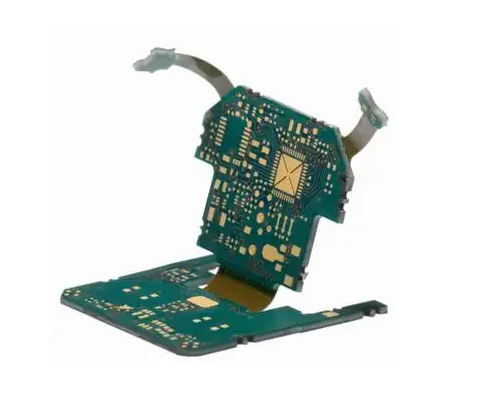
Rigid Flex
For over four decades, the military and aerospace industries have been using rigid flex circuits. Rigid flex circuit boards consist of multiple layers of flexible and rigid materials that form separate rigid and flexible areas in a single package.
Flex board structures are composed of copper circuitry bonded to a polymer (most often polyimide) substrate similar to multi-layered rigid circuit material and taken one step further to flex-circuit as a laminated layer within a flexible PCB.
Copper plated vias connect rigid outer layers to flexible inner layers. Higher component density and improved quality control come with rigid flex circuits. Designs are stiff where additional support to electronic components in SMT form is required, and is and flexible in regions that need to bend and contour to fit into rigid spaces.
Rigid Flex circuits have a multitude of high level advantages, a few include:
Connection Reliability – Rigid layers are connected with flexible cables, this is the principle behind combination rigid flex circuits. Rigid flex constructions remove the need for board-to-board connectors or wiring harnesses to connect rigid boards.
Flexible Design Options –
We guide our customers through the toughest challenges in designing the most stable and efficient designs possible at FASTPCBREVERSE. Both rigid and flexible substrates can be used to design rigid flex circuits where many complex and unimaginable combinations can be achieved. Various types of the above can be incorporated in rigid flex circuit designs:
Highly complex configurations
Controlled Impedance
High layer count
Reduced interconnections
High Density Applications – The removal of interconnecting hardware with a rigid flex release will free space to allow more connections to be piggybacked on a standard PCB. The rigid areas of a rigid flex circuit are usually used for very dense SMT device population. The flexible areas that couple the rigid portions of the circuit enable the circuit to assume a 3-dimensional structure with additional rigid areas on parallel planes that are coupled with the others.
Compact Footprint and Reduced Weight – Flexible circuit materials are extremely thin and it is also possible to create very narrow circuit traces, allowing for a much higher connection density than with traditional circuit boards as well as a significant reduction in the overall weight of the system. This interconnect system is well suited for applications which experience high shock and vibration due to the inherent low mass of rigid flex.
A brief summary, if you want the flexible circuit or flexible printed circuit board solution,call us.